Decoding AI: How Machines Learn, Think, and Evolve
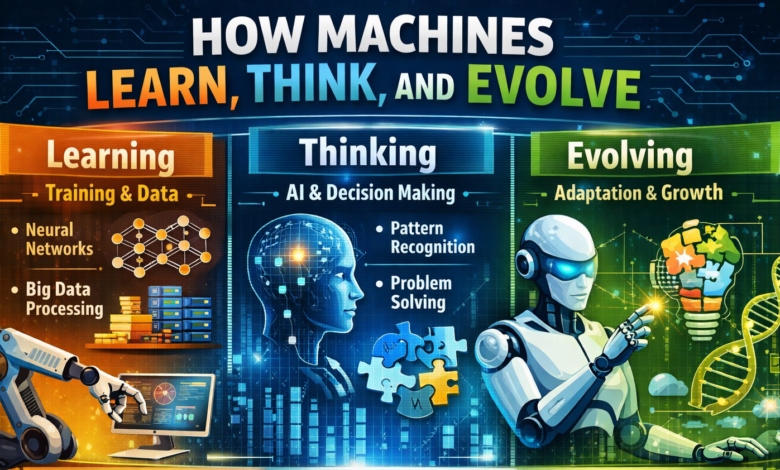
H1: Decoding AI: How Machines Learn, Think, and Evolve
- H2: Introduction to Artificial Intelligence
- H3: What Is AI Really?
- H3: Brief History of Artificial Intelligence
- H2: Types of Artificial Intelligence
- H3: Narrow AI vs General AI
- H3: Reactive Machines vs Self-Aware AI
- H2: How Machines Learn
- H3: Understanding Machine Learning (ML)
- H3: Supervised, Unsupervised & Reinforcement Learning
- H3: Role of Data in Machine Learning
- H2: Deep Dive into Neural Networks
- H3: What Are Artificial Neural Networks?
- H3: How Neural Networks Mimic the Human Brain
- H3: The Magic of Deep Learning
- H2: Thinking Like a Human – Can Machines Really Do It?
- H3: Natural Language Processing (NLP)
- H3: Computer Vision and Pattern Recognition
- H3: Decision-Making and Problem-Solving Capabilities
- H2: Evolution of AI Over the Years
- H3: From Chess to Chatbots
- H3: Breakthroughs in Generative AI (like GPT & DALL·E)
- H3: AI in Robotics and Autonomous Systems
- H2: Real-World Applications of AI
- H3: AI in Healthcare
- H3: AI in Finance and Business
- H3: AI in Everyday Life
- H2: Challenges AI Faces
- H3: Bias in Data and Algorithms
- H3: Ethical and Social Concerns
- H3: The Black Box Problem
- H2: The Future of AI
- H3: Predictions for the Next Decade
- H3: AI and Human Collaboration
- H3: Will AI Ever Reach Consciousness?
- H2: Conclusion
- H2: FAQs
Decoding AI: How Machines Learn, Think, and Evolve
Introduction to Artificial Intelligence
What Is AI Really?
Our world is being shaped by artificial intelligence (AI), which is no longer just a trendy term. But what exactly is AI? Simply put, it describes devices or systems that are capable of carrying out operations that normally demand for human intelligence. Think of recognizing faces, understanding speech, making decisions, or even writing essays like this one!
Brief History of Artificial Intelligence
AI wasn’t created overnight. It began as early as the 1950s with pioneers like Alan Turing, who questioned whether machines could think. The journey has been full of ups and downs—from the AI winters (periods of little progress) to today’s boom in generative AI.
Types of Artificial Intelligence
Narrow AI vs General AI
Most of what we see today—like Siri, Google Translate, or Netflix recommendations—is called Narrow AI. These systems are good at one task. General AI, however, would have human-like intelligence across multiple domains. We’re not there yet, but researchers are trying.
Reactive Machines vs Self-Aware AI
Types of AI can also be categorized according to their capabilities:
- Reactive Machines: Can only react to specific inputs (e.g., IBM’s Deep Blue).
- Limited Memory: These learn from historical data, just like self-driving cars do.
- Theory of Mind and Self-Aware AI: These are still theoretical, aiming for emotional and cognitive understanding.
How Machines Learn
Understanding Machine Learning (ML)
ML is the core engine behind most modern AI. Rather than being explicitly programmed, machines “learn” from data. For instance, you show an algorithm thousands of dog images, and it learns what makes a dog… a dog.
Supervised, Unsupervised & Reinforcement Learning
- Supervised Learning: using tagged data to learn (e.g., spam vs. not spam).
- Unsupervised Learning: No labels; the machine finds patterns (like grouping customers by behavior).
- Reinforcement Learning: Like training a dog with treats, machines get “rewards” for good decisions.
Role of Data in Machine Learning
Data is the fuel of AI. The more diverse and high-quality the data, the smarter the machine becomes. But garbage in = garbage out. Biased or poor data can lead to flawed systems.
Deep Dive into Neural Networks
What Are Artificial Neural Networks?
Inspired by the human brain, neural networks are made up of “neurons” that pass signals and learn from data. They’re the backbone of image recognition, speech processing, and more.
How Neural Networks Mimic the Human Brain
Just like your brain has neurons, AI models have layers of artificial neurons. They connect, adjust weights, and improve over time, mimicking how we learn from experience.
The Magic of Deep Learning
Neural networks with several layers are used in deep learning. It’s what powers language models like ChatGPT or art generators like DALL·E. The deeper the network, the better it can understand complex patterns.
Thinking Like a Human – Can Machines Really Do It?
Natural Language Processing (NLP)
Have you ever wondered how you are perceived by Alexa? That’s NLP. It lets machines read, understand, and generate human language. NLP is used in anything from chatbots to translation applications.
Computer Vision and Pattern Recognition
Computer vision has made machines “see.” They analyze images and videos—used in facial recognition, medical scans, and even identifying spoiled fruits in factories.
Decision-Making and Problem-Solving Capabilities
AI isn’t just about copying humans—it’s about improving. AI can sort through millions of options in seconds to suggest the best course of action. From playing chess to diagnosing cancer, AI is learning how to make better decisions.
Evolution of AI Over the Years
From Chess to Chatbots
From IBM’s Deep Blue beating Kasparov in the 90s to today’s intelligent virtual assistants, AI has evolved from rule-based systems to learning machines.
Breakthroughs in Generative AI (like GPT & DALL·E)
AI can now generate content—text, images, music, and more. GPT models write like humans, while DALL·E creates artwork from words. It’s not just learning anymore—it’s creating.
AI in Robotics and Autonomous Systems
Robots powered by AI are working in warehouses, hospitals, and even in space. Drones navigate without pilots, and robots assist in surgeries with precise accuracy.
Real-World Applications of AI
AI in Healthcare
AI helps detect diseases earlier, personalize treatments, and even predict patient outcomes. Tools like IBM Watson and AI radiology scanners are saving lives.
AI in Finance and Business
From fraud detection to customer service bots, AI improves efficiency and decision-making. It analyzes markets, suggests investments, and even writes reports.
AI in Everyday Life
Your smartphone, smart speaker, Netflix suggestions—AI is already a part of your daily routine. It’s in your emails, maps, and shopping carts, quietly making life easier.
Challenges AI Faces
Bias in Data and Algorithms
AI learns what we teach it. If the data is biased, the output is too. This can lead to unfair decisions in hiring, policing, or lending.
Ethical and Social Concerns
Can AI replace jobs? Is it morally or legally acceptable for AI to make decisions? These questions are at the center of today’s tech ethics debates.
The Black Box Problem
Sometimes, not even the creators fully understand how an AI makes decisions. Accountability and openness are hampered by this “black box.”
The Future of AI
Predictions for the Next Decade
Expect smarter AI, more automation, and even AI partners in education, therapy, and creativity. The way we live and work may change in the upcoming ten years.
AI and Human Collaboration
Rather than replacing us, AI will likely work with us—assisting in complex tasks, crunching data, and even enhancing our creativity.
Will AI Ever Reach Consciousness?
This is the million-dollar question. While machines can simulate intelligence, we’re far from creating conscious, self-aware entities. But the debate is alive and well.
Conclusion
AI is no longer science fiction. It’s here, learning, evolving, and transforming the world in ways we’re only beginning to grasp. Understanding how machines learn, think, and evolve isn’t just for techies—it’s essential knowledge for anyone living in the digital age. One thing is certain as we approach even more significant innovations: the future is intelligent and has already begun.
FAQs
1. What’s the difference between AI, ML, and deep learning?
AI is the broad field, ML is a subset that allows machines to learn from data, and deep learning is a specialized ML technique using neural networks.
2. Can AI truly replace human jobs?
Yes, but it will also create new ones. Upskilling and adapting to work with AI is crucial.
3. How do machines learn from data?
They identify patterns and adjust their algorithms based on input data, feedback, and objectives.
4. Is AI dangerous?
It can be if misused. The focus should be on responsible development, transparency, and ethics.
5. Will machines ever have emotions?
They might mimic emotions, but real human-like feelings require consciousness—something AI doesn’t have… yet.