AI Revolution How Artificial Intelligence is Redefining Every Industry
Outline:
- Introduction
- Definition of Artificial Intelligence (AI)
- An overview of the industry-wide AI revolution
- AI in Healthcare
- Transforming diagnosis and treatment
- AI-powered medical devices
- Personalized medicine through AI
- AI in Finance
- AI-driven trading algorithms
- Fraud detection and risk management
- Personalized banking and financial services
- AI in Manufacturing
- Smart factories and automation
- Predictive maintenance powered by AI
- AI for supply chain optimization
- AI in Retail
- Personalized shopping experiences
- Chatbots and customer service automation
- AI in inventory and logistics management
- AI in Education
- Personalized learning with AI
- AI-driven tutoring systems
- Improving administrative tasks with AI
- AI in Transportation
- Autonomous vehicles and self-driving cars
- AI in logistics and delivery
- Smart traffic management systems
- AI in Marketing
- AI in consumer behavior analysis
- Hyper-personalized marketing campaigns
- AI for content creation and optimization
- AI in Entertainment
- AI-driven content recommendations
- Virtual actors and AI in movie production
- The impact of AI in gaming
- AI in Agriculture
- AI-powered precision farming
- AI in crop monitoring and pest control
- Automation in agriculture through AI
- Ethical Considerations in AI
- Privacy concerns and data security
- The role of AI in job displacement
- AI biases and ethical dilemmas
- Challenges in AI Adoption
- Resistance to change in industries
- The cost of AI implementation
- AI education and skill gaps
- Future of AI: Trends to Watch
- AI in quantum computing
- AI in creativity and art
- The future of AI regulation
- Conclusion
- Recap of AI’s impact across industries
- Final thoughts on AI’s future role
AI Revolution: How Artificial Intelligence is Redefining Every Industry
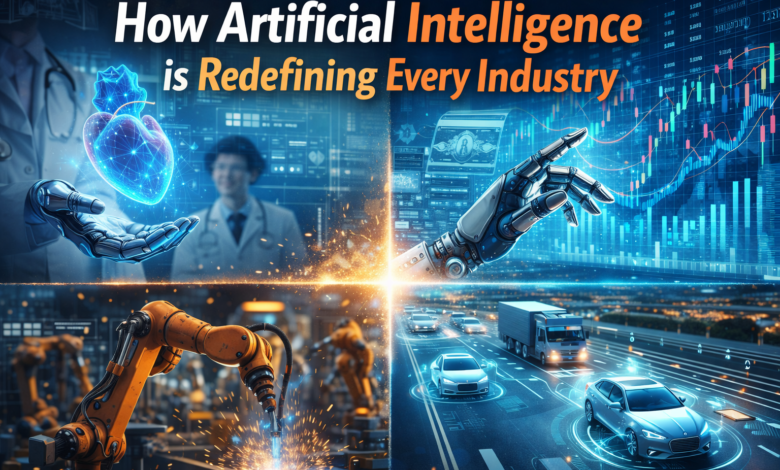
Artificial Intelligence (AI) is a modern reality that is changing industries all over the world; it is no longer a sci-fi idea. From healthcare to agriculture, AI is not only enhancing efficiency but also creating opportunities for innovation that were once unimaginable. Let’s dive into how AI is revolutionizing various sectors and what the future holds for these technological advancements.
AI in Healthcare
AI’s impact on healthcare is one of the most profound, with innovations transforming diagnosis, treatment, and patient care.
Transforming Diagnosis and Treatment
Machine learning algorithms now assist doctors in diagnosing diseases faster and with greater accuracy than ever before. For example, AI systems are used to analyze medical images, detecting early signs of conditions like cancer, often before a human doctor can. This early detection can be a game-changer, improving patient outcomes and reducing treatment costs.
AI-Powered Medical Devices
From wearable health monitors that track vital signs to robotic surgery assistants, AI is making medical devices smarter. These devices not only help in accurate monitoring but can also intervene in emergencies, providing critical support when doctors are unavailable.
Personalized Medicine Through AI
AI is also advancing personalized medicine, which customizes treatment regimens based on a patient’s medical history and genetic composition. AI can forecast which medicines will be most beneficial for a certain patient by evaluating large datasets, which will improve healthcare.
AI in Finance
The financial industry has been quick to adopt AI, using it to improve customer service, enhance trading strategies, and manage risk.
AI-Driven Trading Algorithms
Massive data sets can be analyzed by AI systems to find patterns, trends, and market abnormalities that are impossible for humans to see. This allows for more efficient and profitable trading strategies, including algorithmic and high-frequency trading.
Fraud Detection and Risk Management
AI is also helping financial institutions detect fraudulent activity by analyzing transactional data in real-time and identifying suspicious patterns. Similarly, AI tools are used to assess risk more accurately, ensuring better investment and lending decisions.
Personalized Banking and Financial Services
Gone are the days of generic banking services. AI allows financial institutions to offer highly personalized services, from chatbots answering customer queries to AI-driven recommendations on saving, investing, and budgeting.
AI in Manufacturing
Manufacturers are increasingly turning to AI to streamline their processes, enhance productivity, and minimize downtime.
Smart Factories and Automation
The smart factory’s automation is powered by AI. Machines equipped with AI can self-optimize, learn from each cycle, and work with minimal human intervention. This leads to more efficient production lines and a reduction in human error.
Predictive Maintenance Powered by AI
Predictive maintenance is another area where AI is making waves. By monitoring equipment in real time, AI can predict when a machine is likely to fail and suggest maintenance, saving companies significant costs and preventing production delays.
AI for Supply Chain Optimization
AI is also revolutionizing supply chain management. It can predict demand, optimize routes, and ensure that inventory levels are just right, reducing costs and improving customer satisfaction.
AI in Retail
In retail, AI is enhancing the shopping experience, both online and in-store, by offering personalized services and improving operational efficiency.
Personalized Shopping Experiences
AI analyzes customer behavior to predict what products they’re likely to purchase next. This leads to more personalized recommendations, better-targeted ads, and an overall enhanced shopping experience.
Chatbots and Customer Service Automation
AI chatbots are becoming increasingly popular in handling customer queries 24/7, providing instant responses and freeing up human agents to handle more complex issues. Wait times are decreased and client satisfaction is increased.
AI in Inventory and Logistics Management
AI helps retailers manage their inventory by predicting demand trends, ensuring that products are stocked in the right amounts. It also helps optimize delivery routes, reducing costs and improving delivery times.
AI in Education
Education is another field benefiting from AI, offering personalized learning experiences and automating administrative tasks.
Personalized Learning with AI
AI can tailor lessons to each student’s learning style, strengths, and weaknesses, providing more effective education. Tools like AI-powered tutoring systems can assist students with real-time feedback, allowing for a more individualized learning experience.
AI-Driven Tutoring Systems
AI-driven tutors are becoming more sophisticated, offering personalized help to students who may be struggling with specific subjects. These systems are available anytime, making learning more accessible.
Improving Administrative Tasks with AI
AI is also assisting educators by automating administrative tasks such as grading, scheduling, and student assessments, allowing them to focus more on teaching.
Ethical Considerations in AI
While AI offers tremendous benefits, it’s important to consider its ethical implications, including privacy concerns, data security, and its impact on jobs.
Privacy Concerns and Data Security
As AI systems rely heavily on data, concerns about privacy and data security have become increasingly important. The more AI systems are integrated into industries, the more data they collect, raising the potential for breaches or misuse.
The Role of AI in Job Displacement
One of the most significant concerns about AI is the potential for job displacement. While AI can automate repetitive tasks, it also creates new job opportunities in tech development, data analysis, and AI training.
AI Biases and Ethical Dilemmas
The quality of AI systems depends on the quality of the data they are trained on. If the data is biased, the AI system will reflect those biases, leading to unethical decisions. This is a challenge that must be addressed to ensure AI works fairly for everyone.
Conclusion
The AI revolution is underway, and it’s clear that artificial intelligence is transforming industries in ways that were previously unimaginable. From healthcare and finance to education and retail, AI is not only enhancing efficiency but also creating entirely new opportunities. However, as we move forward, it’s crucial to address the ethical and practical challenges that come with these advancements. AI appears to have a bright future and the capacity to completely transform a variety of sectors.
FAQs
- What is the AI revolution?
The AI revolution refers to the rapid advancement and widespread adoption of artificial intelligence technologies across various industries, transforming business practices, improving efficiency, and creating new opportunities. - How is AI used in healthcare?
AI is used in healthcare for tasks such as diagnosing diseases, monitoring patient health through wearable devices, and personalizing treatment plans based on individual patient data. - Will AI replace human jobs?
While AI may automate certain tasks, it is also creating new jobs, particularly in the tech sector. The key is for workers to adapt and learn new skills in an AI-driven world. - What industries benefit most from AI?
AI is revolutionizing a variety of industries, with notable benefits in healthcare, finance, manufacturing, - How does AI impact customer service?
AI enhances customer service by enabling chatbots and virtual assistants to respond to inquiries 24/7, providing instant support and freeing human agents to focus on more complex issues.
- What are some examples of AI in retail?
AI is utilized in retail for dynamic pricing, inventory control, and tailored suggestions. For example, AI analyzes customer shopping habits to suggest products, ensuring a personalized shopping experience.
- Can AI be used for content creation?
Yes, AI tools are being used to create content like articles, blog posts, social media captions, and even music and artwork. Businesses may quickly and effectively scale their content production with the aid of these solutions.
- Is AI a threat to privacy?
AI can pose privacy risks since it requires large amounts of data to function effectively. This data can include personal and sensitive information, raising concerns about data security and unauthorized access.
- What industries are least affected by AI?
While most industries are seeing some impact from AI, sectors that rely heavily on human creativity, empathy, or physical tasks—such as the arts, therapy, and manual labor—are less likely to be automated by AI in the near future.
- How can businesses adopt AI effectively?
Businesses can adopt AI by identifying repetitive tasks that can be automated, investing in employee training, and gradually integrating AI technologies to optimize operations while considering ethical and privacy concerns.