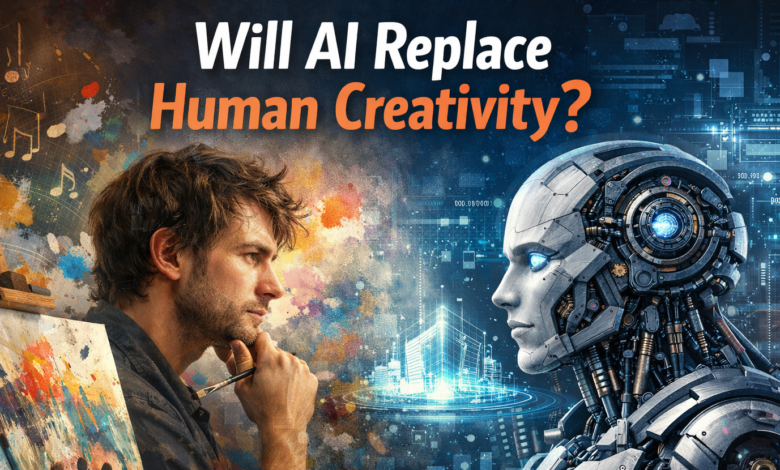
Will AI Replace Human Creativity? Exploring the Boundaries of Machine Innovation
Meta Description: Will AI replace human creativity? Dive into the 2026 perspective on the evolving relationship between machine learning and human innovation.
# Introduction
The rise of artificial intelligence has stirred debates in nearly every industry — but one of the most emotionally charged conversations centers on AI and creativity. Can the core of human creativity be replicated by robotic machines? Will AI replace human creativity in the long run, or will it become just another tool in our hands?
In this article, we’ll explore this provocative question through the lens of art, music, writing, and design. We’ll dive into how AI interprets creativity, the boundaries it currently faces, and whether it can truly compete with the uniquely human spark of imagination.
## What Is Creativity? A Human Perspective
Creativity is more than just producing something new. It involves emotion, context, cultural understanding, and, often, deep personal expression. From painting a canvas to composing a poem, human creativity draws from life experiences, emotional depth, and a drive for meaning.
Creativity includes:
- Originality: Coming up with something unique.
- Problem-Solving: Thinking in novel ways to find solutions.
- Emotion & Empathy: Tapping into feelings to resonate with others.
These traits make human creativity deeply nuanced — and difficult to replicate by machines.
## How Artificial Intelligence Understands Creativity
AI doesn’t “create” in the human sense. Instead, it identifies patterns, learns styles, and recombines data to produce something that appears creative. Machine learning models, especially those like GPT-4 or DALL·E, are trained on massive datasets of human-created content.
How It Works:
- Data Ingestion: AI scans billions of texts, images, or sounds.
- Pattern Recognition: It identifies how humans combine elements creatively.
- Regeneration: AI outputs new content based on learned patterns.
While impressive, AI’s outputs are essentially remixes — not inspired innovations.
## AI’s Past in Creative Industries
AI’s journey into creative domains didn’t start yesterday. Here’s a timeline showing major milestones:
| Year | AI Creative Breakthrough |
|---|---|
| 1950s | Alan Turing’s early musings on machine intelligence |
| 1973 | Harold Cohen’s AARON, an AI painting program |
| 2016 | Google’s DeepDream creates psychedelic images |
| 2018 | A painting by AI sells for $432,500 at Christie’s |
| 2022 | OpenAI’s DALL·E 2 and ChatGPT hit the mainstream |
The progression shows how AI has gradually moved from novelty to integrated creative assistant.
## AI’s Role in Modern Creative Industries
AI tools are already commonplace in everything from marketing to music production. Brands use AI to generate ad copy, create visual content, and even compose jingles. It adds distinctive variances and speeds up production.
AI in Action:
- Marketing: Tools like Jasper and Copy.ai generate SEO-optimized blogs.
- Design: Canva and Adobe’s AI-powered features assist in layout suggestions.
- Music: AIVA and Amper Music compose film scores and background music.
Despite the tech, human oversight remains critical — especially to ensure emotional tone, cultural sensitivity, and brand voice.
## Important Distinctions Between Machine and Human Creativity
Answering our main question—will AI replace human creativity? requires an understanding of the distinctions.
| Aspect | Human Creativity | AI Creativity |
|---|---|---|
| Emotion | Deeply emotional | Emotionless |
| Intent | Purpose-driven | Data-driven |
| Context | Understands nuance | Limited understanding |
| Adaptability | Highly flexible | Rule-bound |
These distinctions show how AI might enhance human creativity rather than take its place.
## Examples of AI-Generated Art, Music, and Writing
🖼 Art:
DALL·E and Midjourney create stunning visual art based on text prompts.
🎵 Music:
AIVA composes classical symphonies — some indistinguishable from human-made.
✍ Writing:
ChatGPT drafts poetry, essays, and articles, mimicking various writing styles.
But here’s the catch — none of these creations carry emotional depth unless guided by a human vision.
## Can AI Really “Think Outside the Box”?
AI is limited to its programming. It can’t invent concepts it hasn’t been trained on. Unlike a child who dreams of flying whales playing chess, AI won’t imagine the impossible unless it’s already seen similar data.
True creativity is characterized by lateral thinking, which is still just human.
## Ethical Implications of AI-Generated Creativity
Who is responsible for the rapid growth of AI-generated material on the internet? What about the original creators whose data trained the AI?
Key Concerns:
- Plagiarism risks
- Copyright ownership
- Loss of human jobs
- Bias embedded in training data
Regulation is evolving, but ethical clarity still lags behind innovation.
## AI as a Supplement, Not a Replacement for Creativity
Rather than replacing humans, AI is better viewed as a collaborator.
Benefits of Collaboration:
- Faster ideation
- Eliminating creative blocks
- Repetitive task automation
- Experimentation with new styles
Artists, writers, and designers are increasingly using AI to enhance, not replace, their vision.
## The Importance of Emotional Intelligence in Creativity
Emotional intelligence fuels empathy, timing, and cultural relevance — things AI doesn’t truly understand.
For example, a human comedian adjusts jokes based on audience feedback. AI can’t interpret emotional nuance the same way.
## The Future of Collaborative Creativity
Human-AI hybrid teams will become commonplace in the future. Schools and companies are already teaching creative professionals how to use AI as a tool, much like Photoshop revolutionized digital design.
In this model, humans steer the vision. AI does the grunt work.
## Industry Leaders’ Perspectives on AI and Creativity
Tech pioneers and creatives offer balanced views:
“AI won’t replace creatives. But creatives who use AI will replace those who don’t.” — Kevin Kelly, Wired Magazine Founder
“Tools don’t create masterpieces — people do.” — Shantell Martin, Visual Artist
## Educational Shifts to Embrace AI Tools
Art schools and writing programs are integrating AI literacy:
- Prompt engineering is being taught alongside traditional creative writing.
- AI-assisted design tools are becoming a standard in curricula.
- Ethics of machine creativity are now part of media studies.
The goal? Show students how to properly and creatively use AI.
## Conclusion: In the Era of Automation, Human Ingenuity
AI is changing the creative landscape — no doubt about it. However, it now serves more as a co-pilot than a pilot.
True creativity stems from human emotion, context, and imagination — realms where AI still stumbles. Rather than fearing replacement, creatives can harness AI to amplify their work, unlock inspiration, and innovate faster.
So, will AI replace human creativity? Unlikely. But it will reshape it — for those willing to adapt.
## Frequently Asked Questions (FAQs)
1. Can AI truly be creative?
AI can mimic creativity by recognizing patterns and recombining data, but it lacks emotional depth and original intent — key components of true creativity.
2. What jobs are most at risk from AI in creative fields?
Entry-level design, copywriting, and data-driven content creation are most susceptible. However, roles requiring strategy, empathy, or innovation remain safe — for now.
3. How can creatives use AI ethically?
By using AI as a support tool, crediting sources, avoiding over-reliance, and respecting copyright laws during content generation.
4. Will schools teach AI creative tools in the future?
Yes. Many already are. Programs now include AI-assisted design, writing with ChatGPT, and prompt engineering as standard components.
5. Is AI-generated art considered “real” art?
That’s subjective. While AI can create visually stunning pieces, many argue that without human emotion or intent, it lacks true artistic soul.
6. Where can I see examples of AI in creativity?
You can explore platforms like OpenAI’s DALL·E or AIVA for music to see how AI is generating art and music today.