The Role of AI in Climate Change: Can Technology Save the Planet?
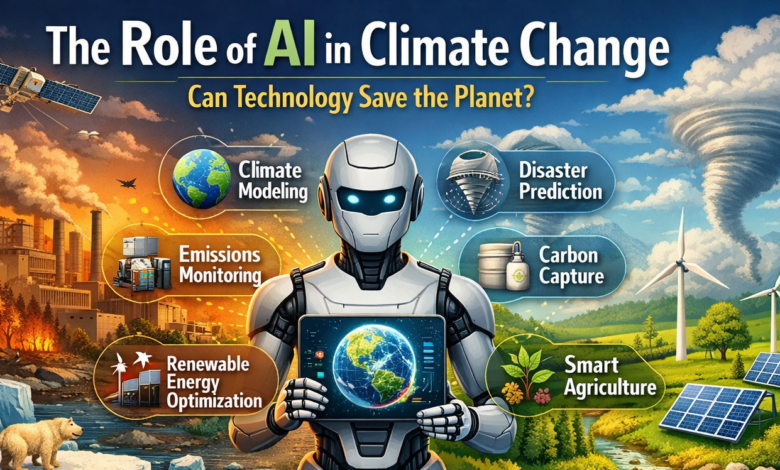
H1: The Role of AI in Climate Change: Can Technology Save the Planet?
- H2: Introduction
- H3: Understanding the Climate Crisis
- H3: The Emergence of Artificial Intelligence (AI)
- H2: The Intersection of AI and Climate Change
- H3: Why AI Matters in Climate Strategy
- H3: Real-time Data Collection and Analysis
- H2: Applications of AI in Climate Monitoring
- H3: Satellite Imagery and Remote Sensing
- H3: Predictive Weather Models
- H3: AI-Powered Disaster Response
- H2: AI for Emission Reduction
- H3: Smart Energy Systems
- H3: AI in Renewable Energy Optimization
- H3: Reducing Industrial Carbon Footprint with AI
- H2: Sustainable Agriculture and AI
- H3: Precision Farming
- H3: Climate-Resilient Crop Models
- H2: AI in Environmental Conservation
- H3: Protecting Forests with AI
- H3: Tracking Endangered Species
- H2: Urban Planning and Smart Cities
- H3: AI for Sustainable Transport
- H3: Smart Infrastructure for Resource Efficiency
- H2: Challenges and Ethical Considerations
- H3: Data Privacy and Security
- H3: AI Bias and Decision-Making
- H3: High Energy Consumption of AI Systems
- H2: Future of AI in Climate Action
- H3: AI Collaboration on Global Scale
- H3: Policy Support and Regulation
- H2: Conclusion
- H2: FAQs
- H3: 1. How can AI help reduce carbon emissions?
- H3: 2. Can AI predict natural disasters accurately?
- H3: 3. What are the risks of using AI for climate change?
- H3: 4. How is AI used in agriculture for sustainability?
- H3: 5. Will AI be sufficient to address climate change on its own?
The Role of AI in Climate Change: Can Technology Save the Planet?
Introduction
Understanding the Climate Crisis
The crisis of climate change is a current reality rather than a threat for the future. From rising global temperatures to devastating floods and wildfires, the Earth’s systems are under immense stress. While human activity has undeniably contributed to this ecological chaos, it’s also human innovation that might help fix it. Enter Artificial Intelligence.
The Emergence of Artificial Intelligence (AI)
AI has transformed industries—healthcare, finance, logistics, entertainment—and now it’s steering its capabilities toward one of humanity’s greatest challenges: climate change. With its ability to analyze massive datasets, predict outcomes, and optimize systems, AI is proving to be more than a tech buzzword. It’s becoming a genuine climate ally.
The Intersection of AI and Climate Change
Why AI Matters in Climate Strategy
Consider attempting to comprehend and resolve a worldwide problem, such as climate change, without a clear map. That’s what it’s like without AI. Traditional methods of tackling climate change—while crucial—are often slow, manual, and lack precision. AI, on the other hand, processes vast amounts of environmental data, offering insights that would take humans years to uncover.
Real-time Data Collection and Analysis
AI thrives on data. From satellites monitoring the atmosphere to IoT sensors in cities, the volume of environmental data is exploding. AI helps make sense of this chaos, detecting patterns in real-time, identifying emission hotspots, and even alerting authorities to developing environmental threats before they escalate.
Applications of AI in Climate Monitoring
Satellite Imagery and Remote Sensing
AI-powered image recognition is revolutionizing how we observe our planet. By analyzing satellite images, AI can detect deforestation, glacier melting, and changes in sea level faster and more accurately than traditional methods. This enables scientists and governments to take action sooner rather than later.
Predictive Weather Models
Ever wondered how meteorologists seem to know exactly when a storm will hit? That’s AI at work. Advanced machine learning models digest terabytes of climate data to improve the accuracy of weather predictions. This is critical in disaster-prone areas, where early warnings can save lives and infrastructure.
AI-Powered Disaster Response
AI can predict where wildfires may spread, how hurricanes will move, or which communities are most at risk during a flood. Armed with this knowledge, emergency services can plan better evacuations, allocate resources smartly, and reduce fatalities.
AI for Emission Reduction
Smart Energy Systems
AI is helping create more efficient energy systems. By predicting energy consumption patterns and dynamically adjusting power loads, AI enables smarter grid management, reducing waste and emissions.
AI in Renewable Energy Optimization
Solar and wind power are inconsistent by nature. AI can forecast weather conditions and adjust energy storage and distribution accordingly. This ensures cleaner energy sources are used more effectively, reducing dependency on fossil fuels.
Reducing Industrial Carbon Footprint with AI
Factories are notorious polluters. With AI, companies can monitor energy usage, detect inefficiencies, and streamline operations to cut down carbon emissions—without compromising productivity.
Sustainable Agriculture and AI
Precision Farming
AI is increasingly used by farmers to assess crop health, weather predictions, and soil conditions. This results in smarter irrigation, pesticide use, and harvesting—minimizing environmental damage while boosting yields.
Climate-Resilient Crop Models
AI can simulate future climate scenarios to determine which crops will thrive in a changing environment. This helps ensure food security without exhausting natural resources.
AI in Environmental Conservation
Protecting Forests with AI
Illegal logging? Forest fires? AI drones and satellites are keeping watch. These tools track how the forest cover changes over time, spot suspicious behavior, and alert the appropriate authorities.
Tracking Endangered Species
AI-based tracking tools help conservationists monitor animal populations, migration patterns, and habitat changes. This data is essential for creating effective protection strategies for threatened wildlife.
Urban Planning and Smart Cities
AI for Sustainable Transport
Traffic congestion equals higher emissions. AI algorithms optimize public transport routes, reduce idling time, and promote electric vehicle (EV) use through smart charging infrastructure.
Smart Infrastructure for Resource Efficiency
Smart cities are integrating AI to manage water usage, waste disposal, and building energy consumption. The result? Urban environments that are cleaner, greener, and more efficient.
Challenges and Ethical Considerations
Data Privacy and Security
While AI depends on data, there’s a fine line between useful information and invasive surveillance. Ensuring privacy in climate tech is a top concern, especially when personal or community data is involved.
AI Bias and Decision-Making
AI is only as objective as the training data it uses. If climate models are fed skewed or incomplete data, the resulting decisions may not be equitable—particularly for vulnerable populations.
High Energy Consumption of AI Systems
Ironically, some AI models require massive energy to train and operate—raising concerns about their own carbon footprint. Green AI practices are becoming more important to address this contradiction.
Future of AI in Climate Action
AI Collaboration on Global Scale
No country can fight climate change alone. Collaborative AI platforms that share insights and innovations globally can accelerate progress. Global data exchange and open-source approaches will be crucial.
Policy Support and Regulation
Technology alone isn’t enough. Governments need to create frameworks that support responsible AI use, fund green innovation, and ensure ethical guidelines are enforced.
Conclusion
AI is not a silver bullet, but it’s certainly one of the most powerful tools we have in the fight against climate change. From monitoring our planet to optimizing how we live and work, AI offers actionable, data-driven solutions that can accelerate climate resilience. The road ahead is long, but with intelligent technology and human willpower, saving the planet is more than just a dream—it’s a plan in motion.
FAQs
1. How can AI help reduce carbon emissions?
AI helps by optimizing energy use, reducing waste in manufacturing, and improving the efficiency of transportation and agriculture—directly cutting down on emissions.
2. Can AI predict natural disasters accurately?
Yes, AI uses historical and real-time data to predict disasters like hurricanes, floods, and wildfires with increasing accuracy, enabling timely responses.
3. What are the risks of using AI for climate change?
Some risks include biased data, ethical concerns around surveillance, and the high energy demands of some AI systems. These challenges require careful regulation.
4. How is AI used in agriculture for sustainability?
AI supports precision farming by analyzing soil, crop, and weather data to optimize resource use—leading to higher yields with lower environmental impact.
5. Will AI alone be enough to solve climate change?
No. AI is a powerful enabler but needs to be part of a larger strategy involving policy change, public behavior shifts, and sustainable practices worldwide.